
Hip Thrust Guide: Dumbbell, Single Leg, Barbell and Machine
The hip thrust loads your glutes at their shortest, strongest position, which is exactly where squats and deadlifts don't. If you want to build glutes, it belongs in your program.
My dumbbell hip thrust tutorial has over a million views, so I'll start there. I'm also going to be honest about why I'd move you off dumbbells once you're past the beginner stage, and what I'd do instead if dumbbells are all you've got.
Quick answer: Set your upper back on a bench around the shoulder blades, feet flat with knees at about 90 degrees at the top, and put the weight in your hip crease on a pad. Tuck your chin, keep your ribs down, drive through your heels and squeeze your glutes for 2 seconds at the top. For glute growth, train mostly in the 10 to 15 or 15 to 25 rep range.
How to do a hip thrust, step by step
The setup is the same whether you're using a dumbbell, a barbell or a machine.
- Back on the bench. Sit in front of a bench and set the base of your shoulder blades on its edge.
- Pad the hips. Put the weight right in your hip crease. Use a squat pad, an AirEx pad or a folded towel, because that spot gets uncomfortable fast.
- Set your feet. Walk your feet in until your knees are at about 90 degrees when your hips are up, shins roughly vertical at the top. Lift once and readjust if you need to.
- Lock in your torso. Tuck your chin, pull your abs tight and keep your ribs down. Your pelvis stays tucked underneath you.
- Lower with control. Let the weight sink your hips down and feel the stretch in your glutes, without letting your ribs flare.
- Drive and squeeze. Drive up through your heels, finish with a hard glute squeeze and hold it about 2 seconds at the top. Lower and repeat.
Single-leg version: same setup, but hug your non-working knee toward your chest and pin it there, with the dumbbell on the working hip. Lower both hips together and drive up level. If you tip, the glute stops working. It takes far less weight to get a training effect, which makes it a good fit at home.
Common hip thrust mistakes (and how to fix them)
| Mistake | What it does | The fix |
|---|---|---|
| Arching the low back to get higher | The extra range comes from your back, not your glutes | Ribs down, belly button in, and stop where your glutes stop |
| Chin up, ribs flaring | Your low back moves around through the rep | Tuck the chin and keep your ribs pinned down |
| Feet too far forward | Hamstrings take over | Walk your feet in to about 90 degrees at the knee |
| Feet too close | Quads take over | Same fix: about 90 degrees at the top |
| No pause at the top | You miss the hard contraction at the top, which is where the glutes do their best work | Squeeze and hold about 2 seconds every rep |
| Relaxing at the bottom or sliding off the bench | Tension drops off between reps | Stay a little higher at the bottom to keep constant tension |
| Single-leg: free leg drifts or hips tip | Hips rotate and the working glute checks out | Pin the free knee to your chest and keep both hips level |
Dumbbell vs. barbell vs. machine: which hip thrust should you do?
Here's my honest take. Dumbbells beat no weight at all, and they're a great place for a beginner to learn the movement. Past that, they have two deal breakers. You run out of weight to progressively overload with, and heavy dumbbells are a pain in the butt to set up and awkward the entire time.
| Version | Best for | Upside | Downside |
|---|---|---|---|
| Machine (my #1) | Anyone with access | Easiest setup, nothing rolls or slides, add weight indefinitely | You need a gym that has one |
| Barbell | Lifters who want to keep getting stronger | Add weight indefinitely, great for glute strength | Fussier setup and you'll need a pad |
| Dumbbell | Beginners and home training | Easy to learn, one dumbbell is enough | Progression runs out, awkward once the weights get heavy |
| Single-leg dumbbell | Fixing side to side imbalances at home | Strong side can't compensate, less load needed | Balance limits how heavy you can go |
The barbell hip thrust is also a smart way to add glute volume if lower back issues stop you from doing many RDLs or deadlifts.
Sets and reps by goal
| Goal | Reps | How to train it |
|---|---|---|
| Glute strength | 5 to 10 | Heavier loads, usually alongside deep squats and RDLs |
| Glute growth | 10 to 15 | Moderate loads with a hard squeeze and pause every rep |
| Glute growth (volume) | 15 to 25 | Moderate to light loads, slow lowering, lots of volume |
If your goal is bigger, more defined glutes, most of your work belongs in the 10 to 15 and 15 to 25 ranges, not in throwing a bunch of heavy weight around. For single-leg hip thrusts, do 3 sets of 8 to 12 per side.
Only have dumbbells? Do step-ups instead
If dumbbells are all you have and you're past the beginner stage, I'd swap the dumbbell hip thrust for one of these three step-ups:
- Crossover step-up
- Inline step-up
- Lateral step-up
According to a review of more than 63 published studies on common lower body gym exercises, these step-up variations produced more glute activation than any hip thrust, lunge, squat or RDL variation in the review. Pair them with dumbbell RDLs and you've got a solid glute day with nothing but dumbbells.
FAQ
Are dumbbell hip thrusts effective?
Yes, for beginners and for training at home. The problem comes later, when you run out of weight to progress with. Then it's time for a barbell, a machine or step-ups.
Why do I feel hip thrusts in my hamstrings or quads?
Foot position. Feet too far forward and your hamstrings take over. Too close and your quads take over. Aim for about 90 degrees at the knee at the top.
Why do I feel hip thrusts in my lower back?
You're arching to get higher. Keep your ribs down and chin tucked, and finish the rep with your glutes, not your back.
How many reps should I do for glute growth?
Mostly 10 to 15 or 15 to 25 reps with a hard squeeze at the top. Keep the heavy 5 to 10 range for strength work.
The bottom line
A dumbbell is a fine way to learn the hip thrust, but plan on moving to a machine or barbell so you can keep adding weight. On any version, keep the ribs down and hold the squeeze at the top for a full two seconds.
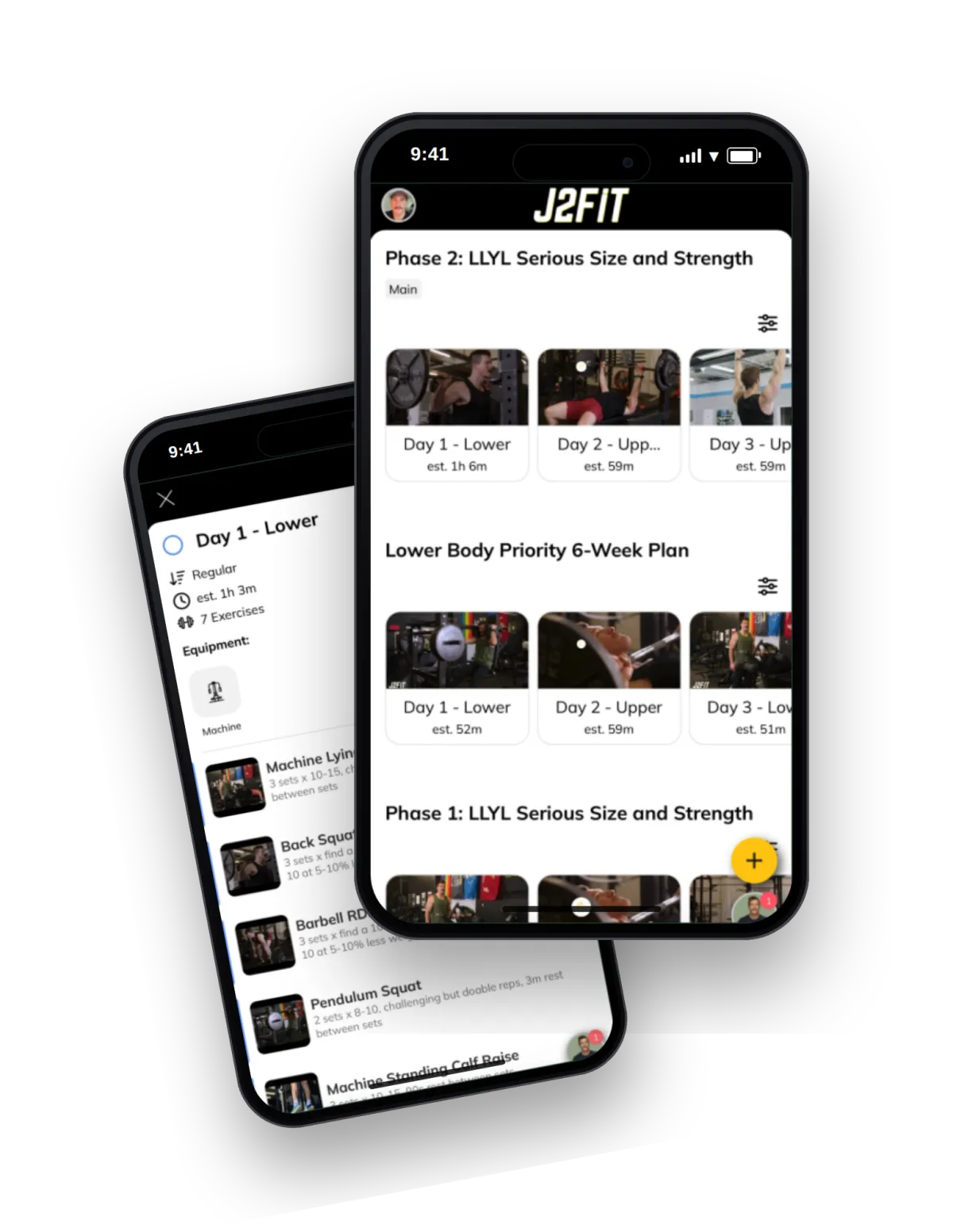
Training at home? My free dumbbell program puts this into a complete plan. Or get every J2FIT program in one app for $29/month.
Coach Mike Dewar, MA, USAW2. Founder, J2FIT Strength & Conditioning. 20+ years coaching, D1 and D3 strength coach.