
Dumbbell RDL: Proper Form, Mistakes and 5 Variations
If you only own dumbbells and you want bigger hamstrings and glutes, the dumbbell Romanian deadlift (RDL) is the lift to master.
Most people who feel it in their low back are squatting it. They bend the knees forward and reach down for the floor, when the knees should stay put and the hips should travel back. Get that hinge right and the stretch moves into your hamstrings.
Quick answer: Stand with your feet about hip width apart, put a soft bend in your knees and freeze it there. Push your hips straight back with a flat back until you feel a deep hamstring stretch, usually around mid-shin, then drive your hips forward and squeeze your glutes at the top. Do 3 to 4 sets of 8 to 12 reps.
What the dumbbell RDL is (and why it works)
The dumbbell RDL builds strength and muscle in your posterior chain: hamstrings, glutes and lower back. For my money, it's the single best hamstring and glute builder you can do without a barbell.
The key is that it's a hinge. Your knees stay slightly bent and stay put. Your hips do the moving, back and then through. Once your knees start traveling forward, it turns into a squat and the stretch leaves your hamstrings.
Dumbbells won't let you load as heavy as a barbell RDL, so this version fits moderate to higher reps when you're training for muscle. It also makes your back and hips work a little harder to stabilize the weights, which isn't a bad thing. If you do have a barbell, I break that version down in my barbell RDL guide.
How to do a dumbbell RDL, step by step
- Set your stance. Feet about hip width apart. Hold the dumbbells at your sides or in front of your thighs. Both work, same idea.
- Set your back. Chest up tall, shoulder blades pulled back and down toward your butt. Don't let your shoulders hunch forward. You want a slight arch in your back.
- Soften the knees and freeze them. A soft bend, not locked out. Once it's set, the knees don't move for the rest of the rep.
- Push your hips straight back. Think about pushing your hips back to the wall behind you while your back stays flat. Abs tight.
- Chase the stretch. Lower until you feel a deep stretch in your hamstrings and glutes. For most people that's around mid-shin.
- Drive your hips through. Pull your hips forward to stand tall and squeeze your glutes hard at the top. Then right back into the next rep: knees stay back, hips back, pull through, squeeze.
Common dumbbell RDL mistakes (and how to fix them)
| Mistake | What it does | The fix |
|---|---|---|
| Bending down instead of hinging back | Moves the work into your low back | Push your hips back to the wall behind you and let the dumbbells follow |
| Knees traveling forward | Turns it into a squat, so the hamstring stretch disappears | Set a soft knee bend and freeze it |
| Rounding the lower back at the bottom | Puts your back at risk | Only go as low as you can with a flat back |
| Over-extending your back at the top | You lean back instead of finishing with your glutes | Abs tight, and finish by squeezing your glutes, not arching |
| Going too heavy too soon | Form breaks down before your hamstrings get the work | Own the hinge first, then add weight |
Sets, reps and programming
Start with 3 to 4 sets of 8 to 12 reps. Dumbbell RDLs shine in moderate to higher rep ranges, so you don't need a heavy load to make this work. What matters is a full stretch on every rep and a hard glute squeeze at the top.
When 8 to 12 gets easy and you don't have heavier dumbbells, don't just add reps. Make the movement harder with the variations below. I also wrote up how to keep progressing with one pair of dumbbells.
5 dumbbell RDL variations to keep progressing
Sometimes you don't have heavier dumbbells. Sometimes one hamstring does more of the work than the other. And sometimes doing the same thing every week just gets boring. These variations fix all three, and you program them the same way as a regular dumbbell RDL.
1. Staggered stance RDL
The bridge between two-leg and single-leg RDLs. Slide one foot back, toe lightly touching and heel off the floor. Think 70/30: the front leg does the work and the back foot is just a kickstand. Hinge with your weight over the front foot and feel the stretch in the front hamstring. Both hips go back together, and don't let the hip open up at the bottom. Do 3 sets of 8 to 12 per side.
2. Deficit RDL
Most people stop around mid-shin. The deficit RDL extends the range of motion for a bigger stretch on the hamstrings at end range, which has been shown to help muscle growth. Go all the way down, pause briefly at the bottom and come back up. If you have the flexibility, stand on a block for more depth, as long as your back stays arched.
3. Single-leg RDL
Training one leg at a time builds balance and stability through the hips, with a little glute medius work on the side, and helps fix imbalances, like feeling your right hamstring more than your left. Use one or two dumbbells, keep the non-working foot ready as a kickstand, and kick that leg back as you hinge. Don't let the outside hip turn up toward the ceiling. Both cheeks go back to the wall behind you.
4. Stiff-leg deadlift
Just like it sounds: your knees are basically straight instead of softly bent. The straighter the knees, the more stretch on the hamstring. You won't go as low and you'll use a lot less weight. That's the point when you don't have heavier dumbbells. Keep your back set and don't hyperextend the knees. You're chasing that nasty stretch.
5. Supported single-leg RDL
Hold a rack, a wall or a chair with one hand and hinge on one leg. The support isn't there to pull yourself up. It just keeps you in your path so balance stops being the limiter. More stability means more force, and more force means more muscle.
Want more glute work after this? My hip thrust guide pairs well with RDL day.
FAQ
What muscles does the dumbbell RDL work?
Your posterior chain: mainly the hamstrings and glutes, with your lower back working to hold a flat position.
How far down should I go on a dumbbell RDL?
Until you feel a deep hamstring stretch, usually around mid-shin, while your back stays flat. If your back rounds, you went too far. The deficit RDL is how you earn more depth.
Why do I feel RDLs in my lower back?
You're probably bending down instead of hinging back, or letting your knees drift forward. Freeze the knees, push your hips back and keep your abs tight.
What's the difference between an RDL and a stiff-leg deadlift?
An RDL keeps a soft bend in the knees. A stiff-leg deadlift keeps them basically straight, which puts more stretch on the hamstring but limits your depth and the weight you can use.
The bottom line
Freeze the knees and send the hips back until the hamstrings are stretched, then squeeze your glutes to stand up. When the dumbbells get light, reach for a variation before you reach for more reps.
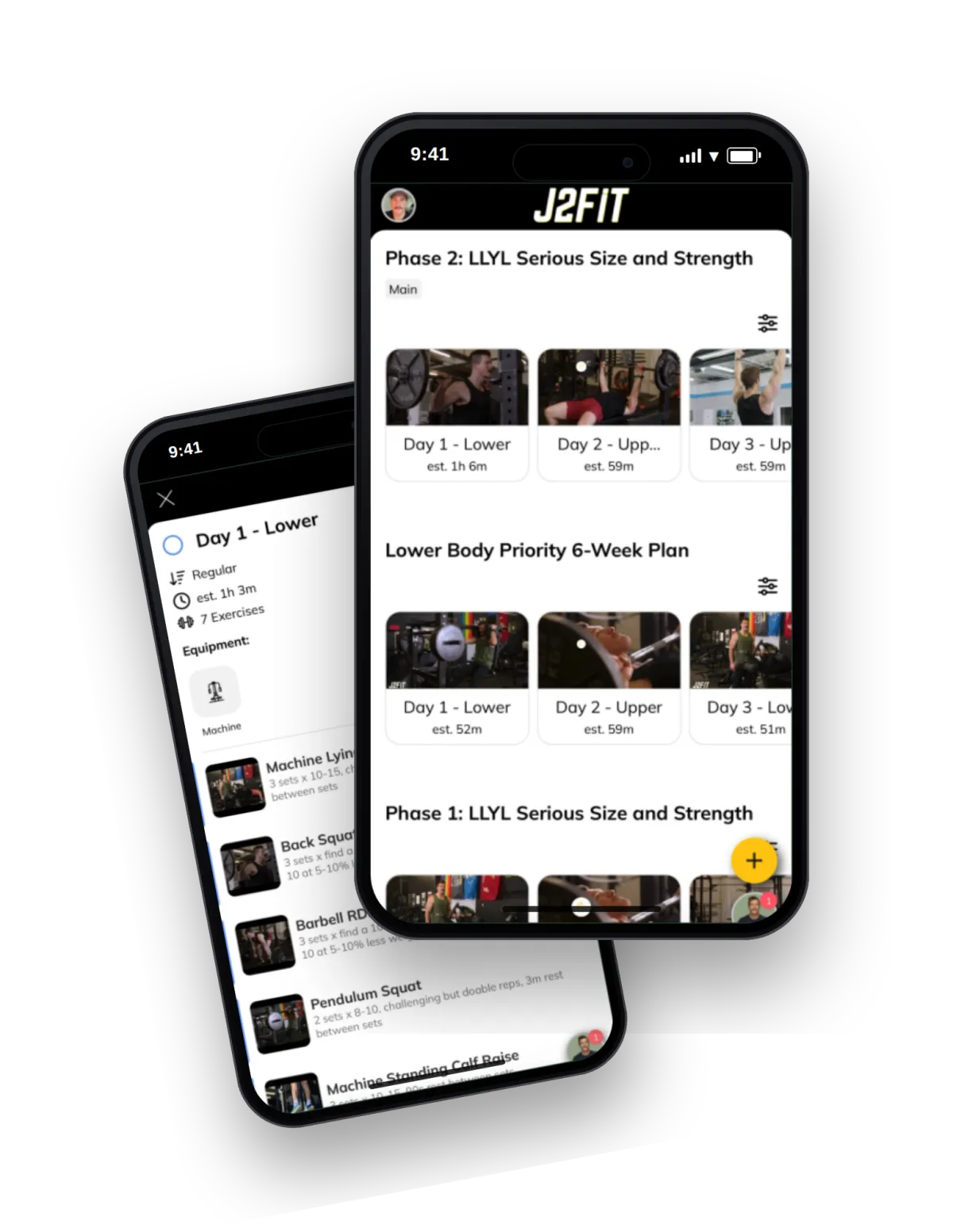
Want the full plan? My free dumbbell program builds the RDL into a complete, no-gym-required routine. Or get every J2FIT program in one app for $29/month.
Coach Mike Dewar, MA, USAW2. Founder, J2FIT Strength & Conditioning. 20+ years coaching, D1 and D3 strength coach.