How Do You Progress Workouts as a Non-Beginner?
The Short Answer
As a non-beginner, you progress one lift per session on purpose and let everything else progress opportunistically.
The first exercise of the day is the one the session was built around. This is where you plan for a new number. Everything after it gets honest effort and a target to hold, and you take a jump only on the weeks it shows up. Expecting every exercise to improve every week is the single most common reason an intermediate lifter concludes a working program has stopped working.
Two things change once you're past the beginner stage: progress has to be aimed rather than collected, and your readiness stops resetting on a weekly cycle.
Table of Contents
Why did linear progression stop working?
Which lift should you actually try to progress?
What does a realistic month of progression look like?
Should you still try to progress your second lift?
Does progression always mean more weight?
Can you push two main lifts at the same time?
Why does week four feel harder than week two?
How do you tell fatigue from a real stall?
Should I try to progress every exercise every week?
How often should my second lift go up?
Is it bad if my accessory lifts go down some weeks?
Why does the same weight feel heavier in week four than in week two?
Can I run two priority lifts in the same block?
If I'm ten pounds under my target, should I still train?
Does progression have to mean adding weight?
Why did linear progression stop working?
When you were new, everything went up. Every week, every lift, no thought required. That stopped a while ago and nobody explained why, so most people quietly decided the problem was them.
It isn't. As a beginner you were adapting to the act of training, which meant every exercise was a new stimulus and every session moved the needle. That well runs dry. What replaces it is a much narrower kind of progress: you get better at the specific things you aim at, and you hold ground everywhere else while you aim.
Which means the job changed. You're no longer collecting progress. You're allocating it.
Which lift should you actually try to progress?
The one the session is built around, and you decide which one that is before you walk in.
There's a difference between training a lift and prioritizing it. Training it means it's in the session getting real work. Prioritizing it means it goes first, it gets the freshest nervous system, it gets your best positions and your full attention, and it's the one where you're actively hunting a better number. You can train five things in a session. You can prioritize one.
Your first lift might be a snatch, a clean, a squat, or a heavy pull. What matters is that the decision was made in advance, not discovered halfway through the session when you noticed you felt good.
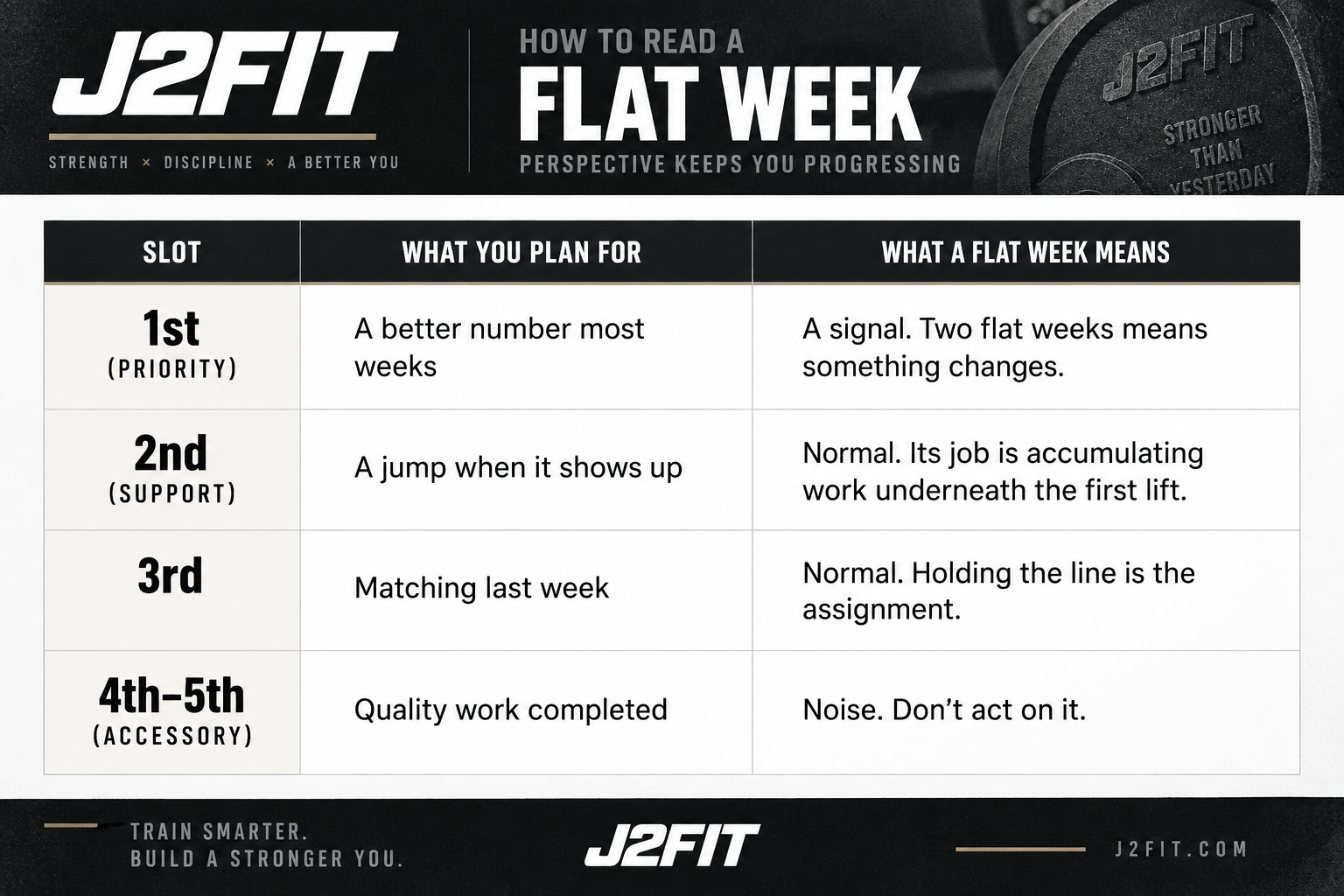
Everything after it gets a different job, and the further down the list you go, the less a missed number means.
Read that table carefully, because the common misreading is that effort declines down the column. It doesn't. You should still be working hard on exercise five. What declines is your expectation of a new number, and what a missing number is allowed to mean.
What does a realistic month of progression look like?
Three ups, one up, and a wash. All three were trying, and that was a good month.
The first lift is where the attention went, so it moved most weeks: a little more weight, a cleaner rep, one more quality set. That's the line you watch. When it goes flat two weeks running, something needs to change.
The fourth exercise is the one that panics people. It came down in week two, jumped past baseline in week three, and finished slightly below where it started. That is what happens to the fourth thing you touch after you've already spent yourself on the thing that mattered. Some weeks it goes up because you slept. Some weeks it comes down because you didn't.
None of this is you not trying. What changes as you move down the list is how likely a new number is, and what it means when it doesn't come. Miss on your first lift two weeks running and that's a signal. Miss on your fifth and it's noise.
Should you still try to progress your second lift?
Yes. Try on all of them. The distinction is not permission, it's expectation.
Your second lift went up once in four weeks in the chart above. That wasn't because it was told to sit still, it may just take more than a week until it shows up. It just didn't show up until week three, and that was fine, because its main job that month was piling work underneath the first lift while the first lift got the credit.
One jump in four weeks on your second exercise is a good month, not a stalled one.
Where people go wrong is grading the second lift against first-lift standards, deciding the program is broken, and either forcing loads that aren't there or abandoning a block that was working.
Does progression always mean more weight?
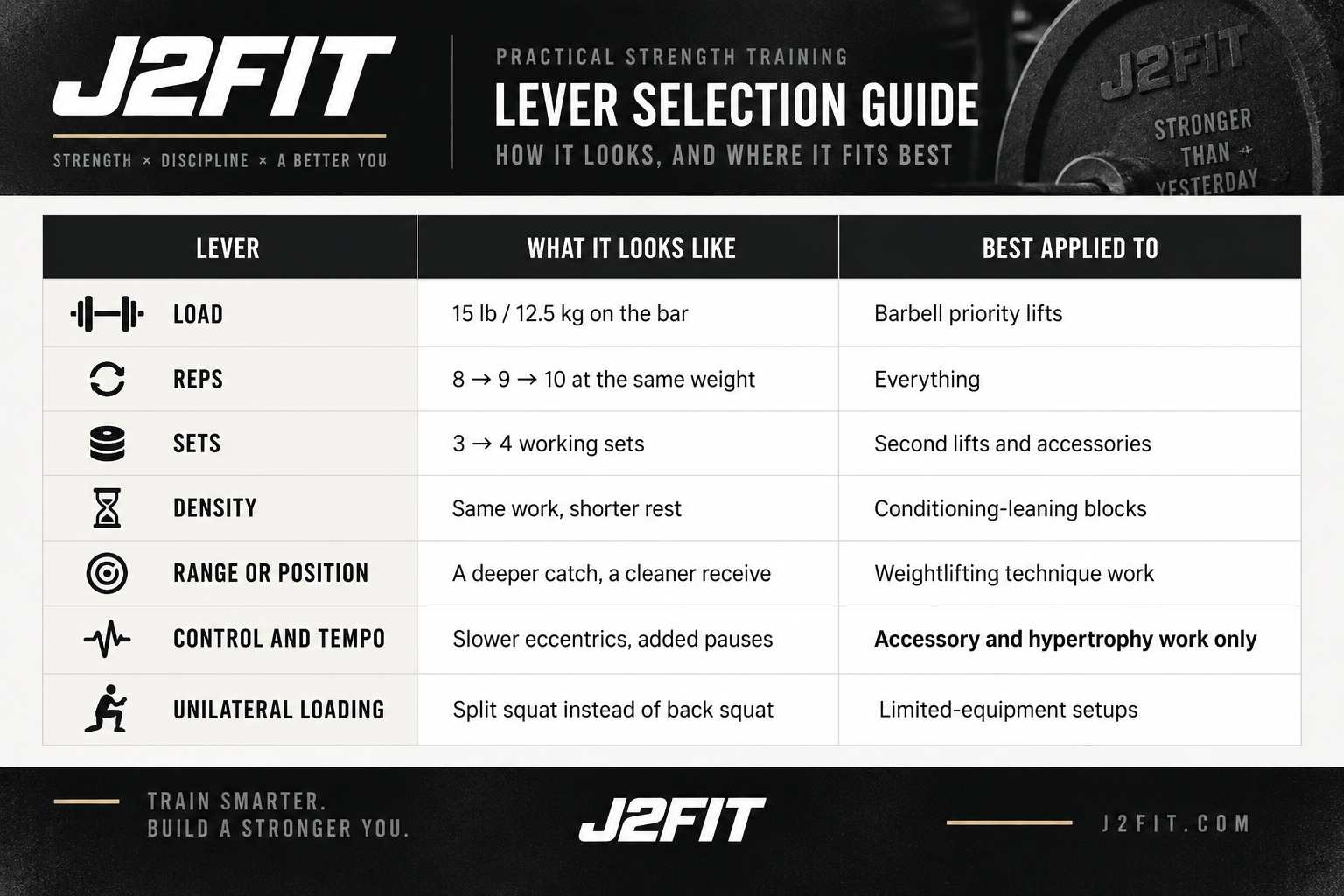
No, and treating load as the only lever is what makes people think they've plateaued when they haven't.
Can you push two main lifts at the same time?
You can. What you can't do is expect two priorities to move the way one would.
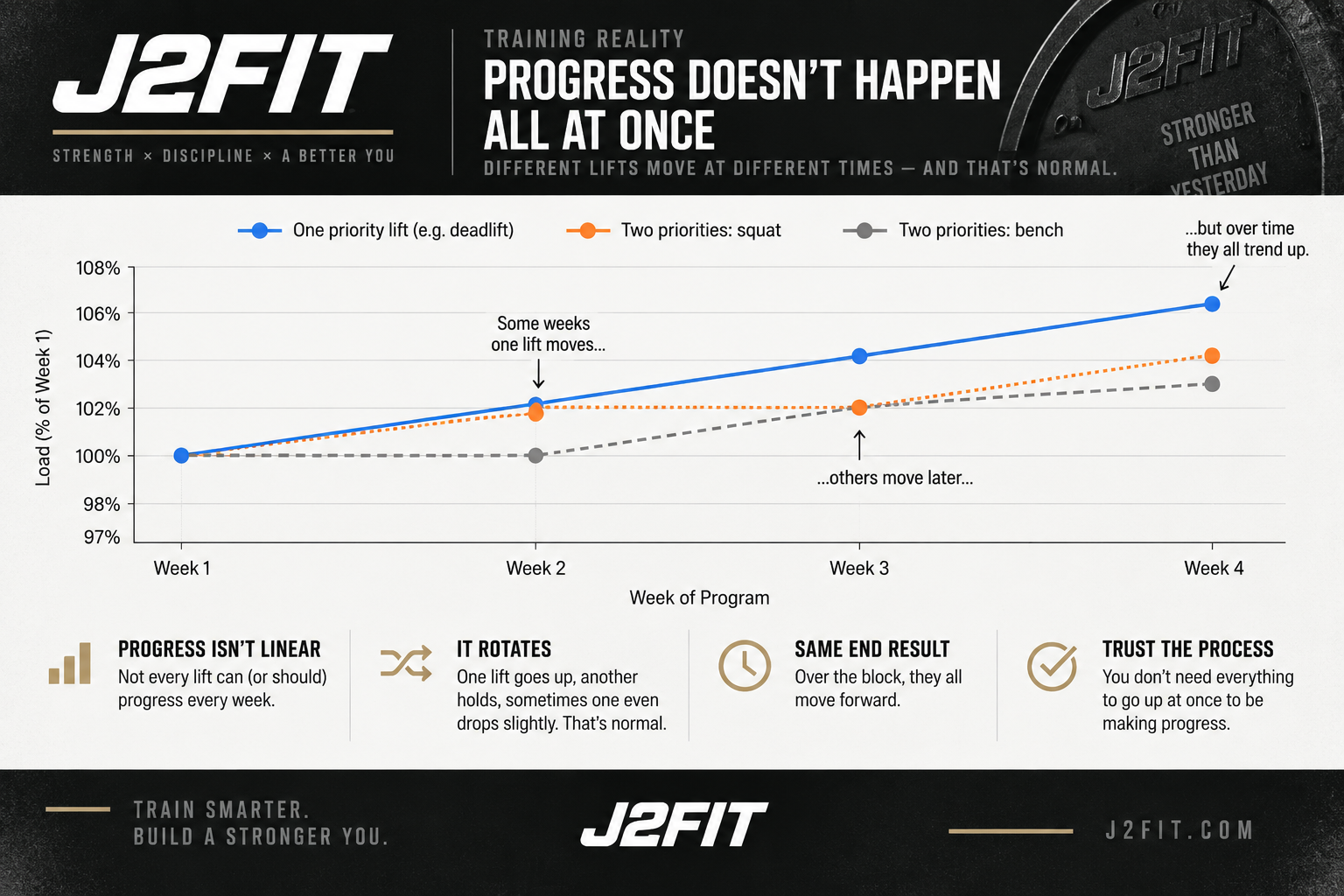
Recovery is a fixed budget and running two lifts hard doesn't grow it. It splits it. Each lift climbs at roughly half the rate, and they tend to alternate: one jumps this week, the other holds, then they swap. Over the block both are up, just not the way either would have been alone.
That's still a good trade when you need both. The failure mode is running two priorities and then grading yourself against what one priority would have produced.
Why does week four feel harder than week two?
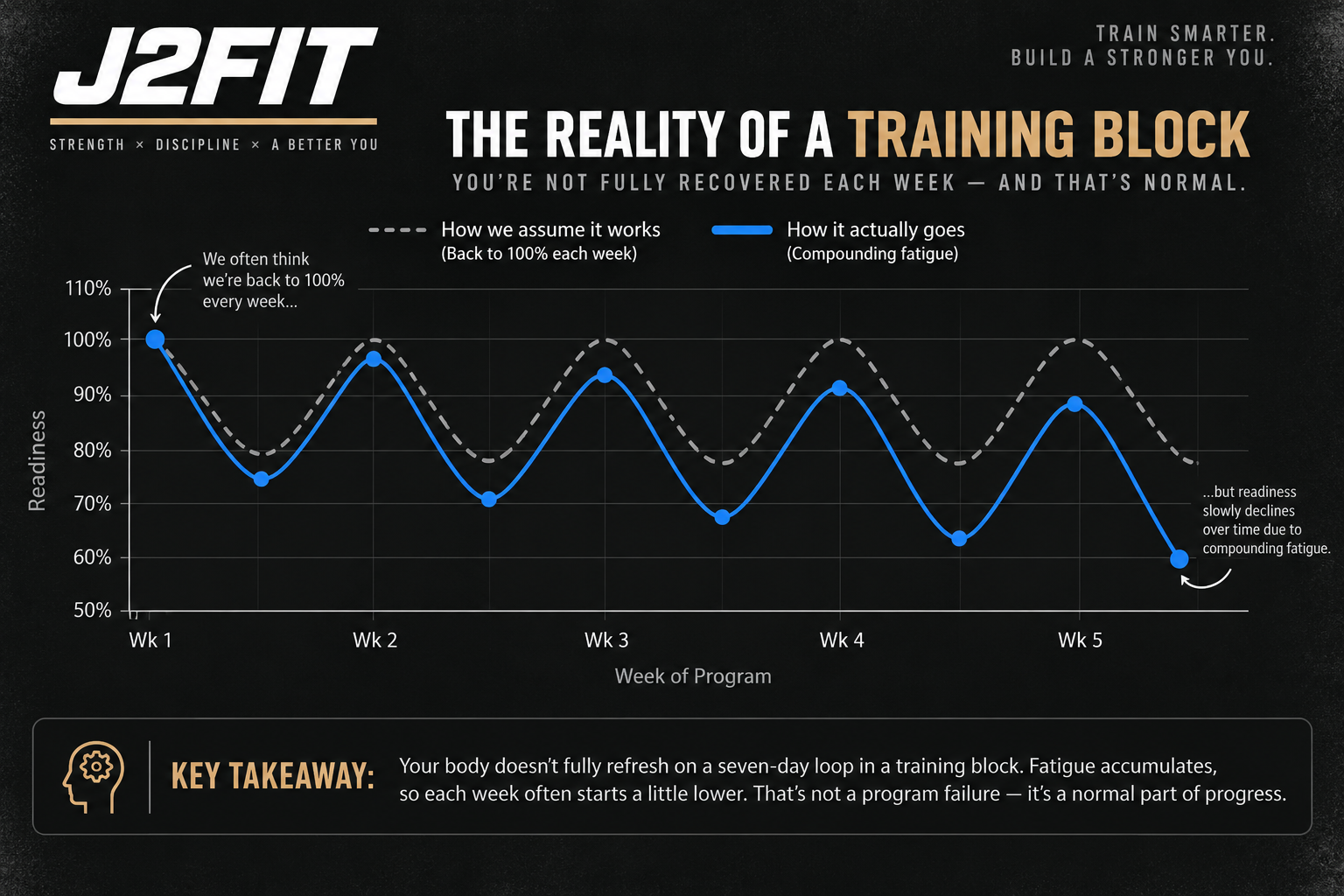
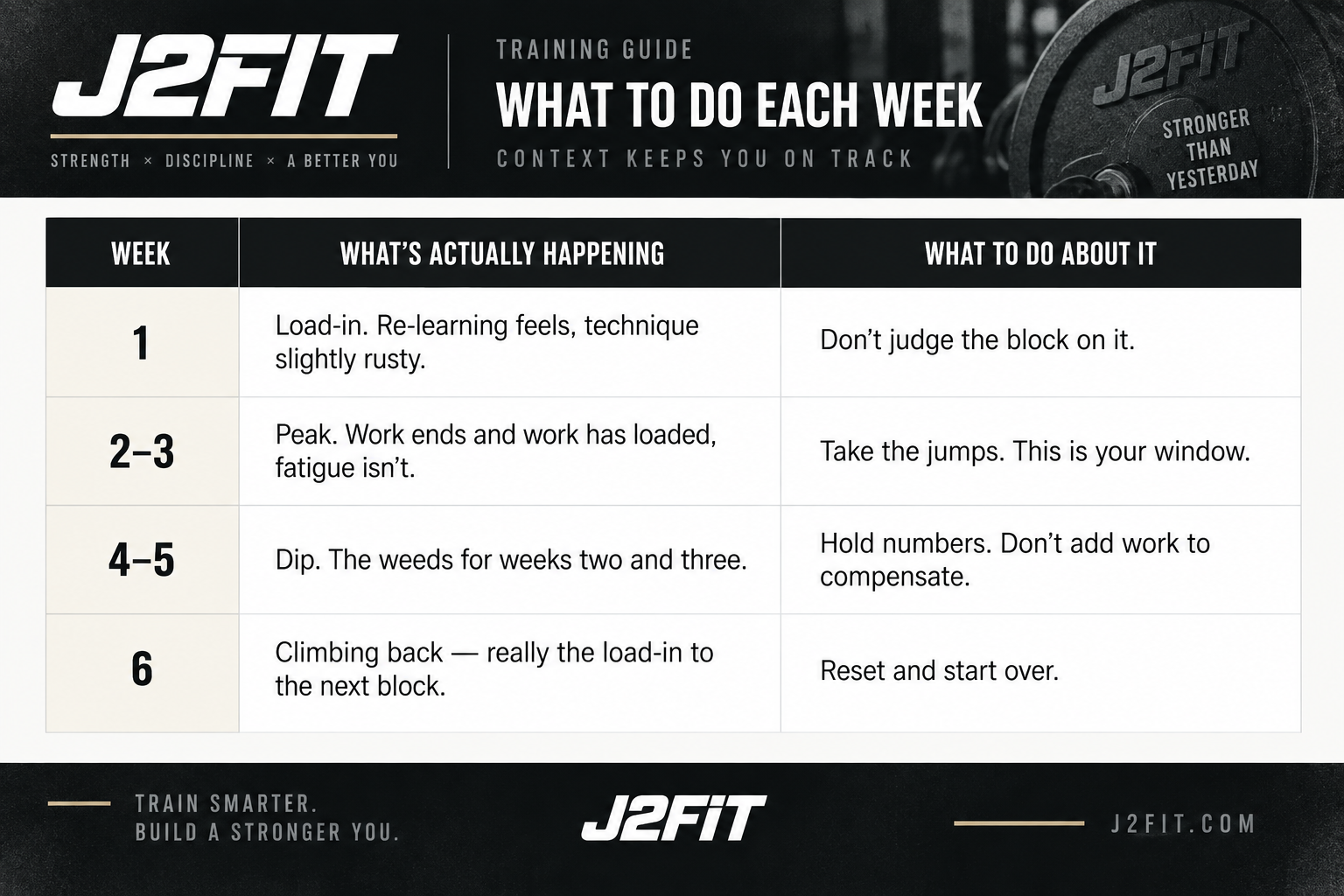
Because your readiness doesn't reset on a seven-day cycle just because your calendar does.
Week one you're not at your best and you shouldn't be. Plenty of people write off week one as a bad week when it's doing exactly what it's supposed to do.
Weeks two and three are when you're flying. Almost every good session in a block lives right here.
Then four and five arrive, the weights feel heavier, and nothing about the program changed. Here's the part that catches people: you expect week five to be your best week, because it's the latest week and you've done the most work. It's usually your worst. Your peak was three weeks ago and you spent it without noticing.
And the climb at the end isn't the same block recovering. That's the next one starting, which is the whole argument for running blocks rather than running forever. You don't get out of the dip by pushing through it. You get out by starting over with a lead-in week.
How far off is too far off?
Less far than you think, and the arithmetic is worth memorizing.
If you squat 450 and you show up ten pounds light, you're two percent off. You wouldn't blink at a two percent swing in your bodyweight or your sleep. But you'll read it as a wasted session, and then you'll do one of two damaging things: force it and dig the hole deeper, or skip the day entirely.
Ten pounds off with real intent still buys you the adaptation. Skipping buys you nothing.
The heavier you get, the more true this becomes, which is exactly backwards from how most strong lifters behave about it.
How do you tell fatigue from a real stall?
This is where the Camp One vs. Camp Two distinction earns its keep.
Camp One is perceived effort: how hard the set felt.
Camp Two is physiological effort: what the set actually cost you and what it actually bought. In week four these two come apart. The set feels like a nine because you're carrying accumulated fatigue, while the physiological demand is the same eight it was in week two.
A fatigue week and a stall week feel identical from the inside. What separates them is pattern:
Fatigue shows up across the board, arrives on schedule around week four or five, affects warm-ups as much as work sets, and resolves with a lead-in week. Your first lift is down along with everything else.
A real stall is specific. It's one lift, it doesn't track the block calendar, warm-ups feel normal, and it's still there after you've backed off and come back fresh. That's when exercise selection, technique, or the block structure itself needs to change.
The practical version: if your priority lift is flat two weeks running and you're not in the back half of a block, treat it as a stall. If everything is heavy and you're in week four, treat it as the calendar.
Frequently asked questions
Should I try to progress every exercise every week?
No. Plan to progress your priority lift and take progress on everything else when it appears. Trying to force new numbers across five exercises means competing demands on a fixed recovery budget, and typically nothing moves well.
How often should my second lift go up?
Roughly once every three to four weeks is normal for an intermediate lifter running one clear priority. If it's moving faster than that, take it. If it hasn't moved in six weeks and your priority lift is climbing, that's still usually fine.
Is it bad if my accessory lifts go down some weeks?
No. Accessories are performed after you've already spent your best effort on the priority work. Weekly variation in accessory performance mostly reflects sleep, stress, and accumulated fatigue rather than lost strength or a failing program.
Why does the same weight feel heavier in week four than in week two?
Readiness accumulates fatigue across a block rather than resetting weekly. Weeks two and three are typically your highest-output weeks, and the cost of that output shows up in weeks four and five even though the program didn't change.
When should I deload?
Most commonly at the back end of a four to six week block, when readiness has dropped, prescribed loads feel disproportionately heavy, and performance is down across multiple lifts rather than just one. A lead-in week at reduced load usually resolves it.
Can I run two priority lifts in the same block?
Yes, but each will progress at roughly half the rate of a single priority, and they will tend to alternate rather than climb together. Judge the block on the combined result, not on what one lift alone would have done.
If I'm ten pounds under my target, should I still train?
Yes. On a heavy squat, ten pounds is often two to three percent — well inside normal daily variation. Training at that load with real intent produces the adaptation. Skipping produces nothing.
Does progression have to mean adding weight?
No. Reps, sets, rest density, positional quality, and control are all legitimate forms of progression, and they matter more the more limited your loading increments are.
Key takeaways
Decide which lift the session is built around before you train, and give it the freshest version of you.
Try on every exercise. What changes down the list is the expectation of a new number, not the effort.
A missed number on your first lift is a signal. A missed number on your fifth is noise.
One jump in four weeks on your second lift is a normal, productive month.
Load is one progression lever among several: reps, sets, density, position, and control all count.
Slow, controlled tempo work belongs to accessories and hypertrophy, not to heavy compounds or explosive lifts.
Two priority lifts split one recovery budget; expect each to move at roughly half speed.
Weeks two and three are usually your best weeks. Weeks four and five are usually the invoice.
Ten pounds off a heavy squat is two percent. Train it anyway.
Fatigue is broad and arrives on schedule. A stall is specific and survives a lead-in week.
About the author
Mike Dewar is the founder of J2Fit Strength & Conditioning, with training facilities in Cincinnati and New York City. He holds a B.S. in Exercise Science from Bowling Green State University and an M.A. in Exercise Physiology from Columbia University and is a USA Weightlifting Level 2 Advanced Coach (a career that started in 2010 as a Division I strength and conditioning intern at Bowling Green State).
He's spent more than nearly 20 years coaching everyday lifters, busy professionals, and competitive weightlifters, and still competes himself, most recently representing Team USA at the 2022 World Masters Weightlifting Championships, where he finished fifth overall in the 89kg class for ages 35–39. He has written over 700 articles and videos on strength training, muscle building, and nutrition, including work for BarBend, Fitbod, and YouTube.