How Hard Should You Actually Train Legs? A Real Leg Day Breakdown
Jake is a beginner lifter with a physique show about six months out. He's not chasing a number on a barbell — he's trying to build as much muscle as possible in the time he's got, and leg day is one of the two sessions a week doing the heavy lifting for that goal.
I coached him through a full leg session recently, and rather than just tell you what "training hard" is supposed to look like, here's exactly what it looked like — the exercises, the tempo, and the coaching cues that actually separate a productive set from a wasted one.
The Session: Compound First, Isolation Second, Unilateral to Finish
The session ran three exercises, in a deliberate order:
- Hack squats — the main compound movement, straight sets in a 12–15 rep range for five total sets.
- Seated hamstring curl — high-rep isolation work, finishing with some forced reps.
- Bulgarian split squat (rack-assisted) — single-leg work with hand support for balance, so the working leg — not stability — was the limiting factor.
That order isn't arbitrary. You want your heaviest, most technically demanding compound movement first, while you're freshest. Isolation work comes next, when a little more fatigue doesn't compromise the movement. And unilateral, balance-dependent work goes last — with assistance if needed — so you're not fighting for stability on tired legs at the exact moment you want to be focused on driving muscle growth.
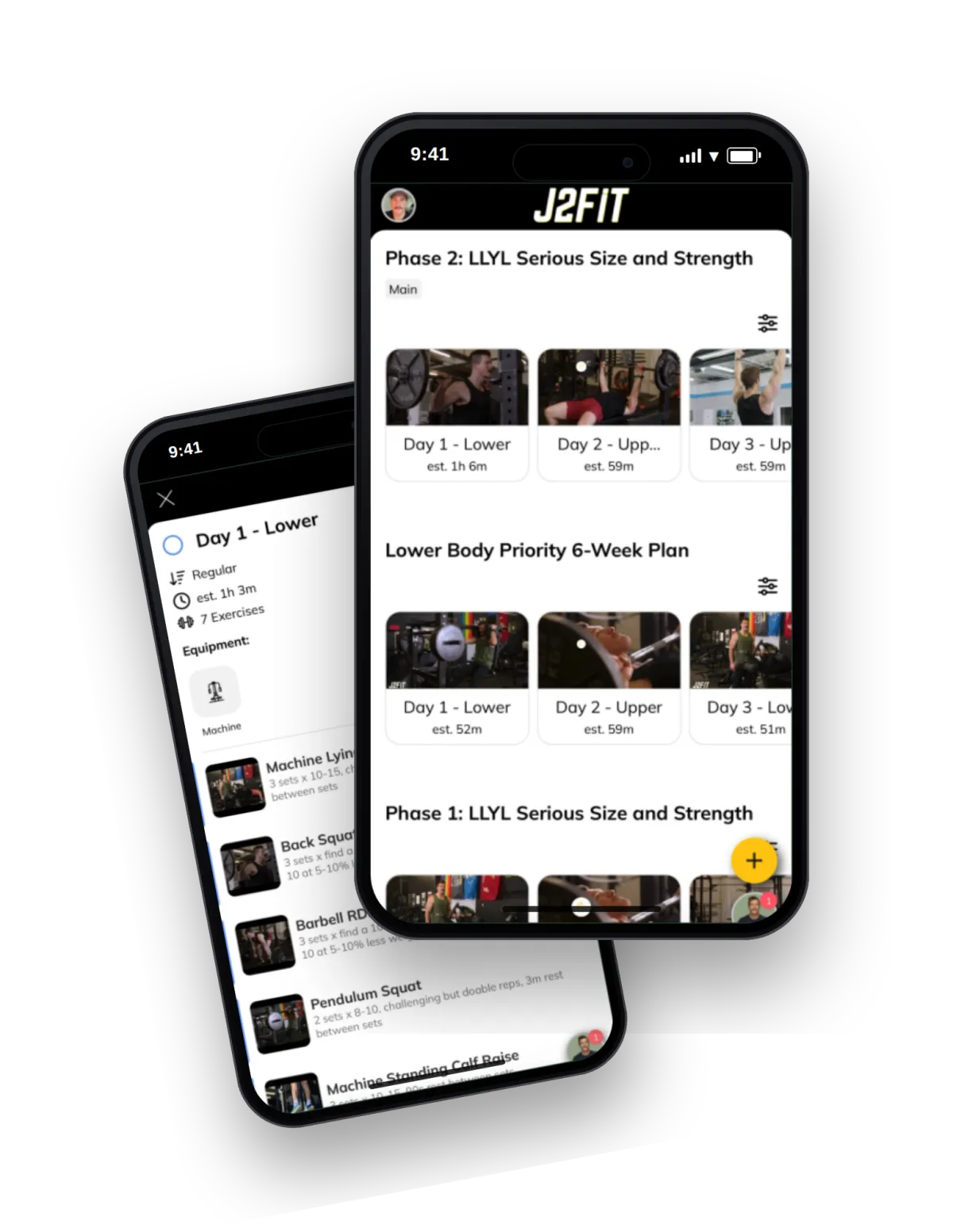
Want a full program built with this kind of exercise sequencing already done for you? Check out the gym series workout plans — 3, 4, and 5-day programs — or explore what's inside the J2FIT workout app.
What "Training Hard" Actually Looks Like
Here's the part most people get wrong: training hard isn't about moving fast or grinding out ugly reps. It's about controlling tempo, especially on the eccentric (lowering) portion of a lift.
On the hack squats, the cue was simple and repeated constantly: smooth and consistent on the way down, no speeding up as you get lower, minimal pause at the top before the next rep. That control does two things — it keeps tension on the muscle for longer (which drives more growth per rep), and it protects your joints, because most training injuries happen when people lose control of a rep, not when they're moving with intent.
The real marker of a hard, well-executed set: your first rep and your last rep should look the same in terms of tempo and control. It's fine if the bar moves slower on the way up as you fatigue — that's expected. What shouldn't change is how controlled the lowering phase stays, rep to rep.
By the last couple of reps of a hard set, you'll see the athlete pause briefly at the top just to gather themselves before the next rep — that's normal, and it's a sign they're actually working near failure rather than stopping short of it.
What to Do When You Miss Your Rep Range
A real question came up mid-session: what if your program says 12–15 reps and you only get 8?
The answer matters more than it seems. If you're consistently falling short of your target rep range, that's not a form problem or a willpower problem — it's a loading issue. Drop the weight slightly until you're landing back in your intended range.
The flip side matters just as much. On Jake's very first hack squat set, he hit 15 reps — the top of his range — and clearly had a couple more reps left in the tank. The call was to add weight immediately rather than repeat the same load. He hit 15 again with the heavier weight, which confirmed it: if you're consistently outperforming your rep range, you need to add load to get yourself back into it.
Working in a rep range instead of a fixed number (like "4 sets of 10") gives you this built-in feedback loop. Some days you'll be in a higher range like 12–20, other days more like 5–10 depending on the exercise and the goal — but as long as you're inside that range, you're on track. Consistently landing outside it, high or low, is your program telling you to adjust the load.
Why Hamstring Training Needs Two Angles
The session paired a seated hamstring curl with RDLs for a specific reason: the hamstring has two functional attachment points, and no single exercise trains both.
The seated curl works the hamstring at the knee joint — a fixed position that isolates the muscle through knee flexion. RDLs work the hamstring at the hip, through a hinge pattern that brings the glutes into play as well. A well-built leg program includes both angles rather than relying on one movement to do all the work.
On the seated curl specifically, the coaching focus was on being explosive pulling the heels toward the glutes, then controlled and slow on the way back out — treating the hamstrings like the fast-twitch-dominant muscle they are, and getting a deliberate stretch at the top of each rep by straightening the knee fully.
Why We Assisted the Unilateral Work
By the time Jake got to Bulgarian split squats, his legs were already fatigued from two exercises. Using a rack for hand support wasn't about making the exercise easier — it was about removing balance as the limiting factor, so the working leg could be pushed close to failure without the set ending early because of a stability issue instead of a muscular one.
That's a useful principle beyond this one session: if an exercise has a stability component, decide whether you're training that stability on purpose, or whether it's getting in the way of the actual muscle-building stimulus you're after. Sometimes the right call is to assist it and let the target muscle do the work.
The Bottom Line
Jake survived leg day — and more importantly, he trained it the way that actually builds a physique: heavy compound work first, controlled tempo throughout, isolation work in a defined rep range with real feedback on when to add load, and unilateral finishing work with the right amount of assistance to keep the target muscle as the limiting factor.
That's the difference between a leg day that just makes you tired and one that actually moves the needle six months out from a show — or toward whatever your own goal is.
If you want a program built around exactly this kind of structure and progression, check out the gym series workout plans (3, 4, and 5-day options depending on your schedule) or explore full programming inside the J2FIT workout app.
Follow the Program.
Structured, progressive training built for people who want to look like they lift.
Get the AppTake the 60 Second Quiz— Mike