What to Expect at Your First Weightlifting Meet
You've put in the training. You've hit your numbers in the gym, over and over, in a quiet room with people you know. And now you're standing in a warm-up area you've never seen before, surrounded by lifters you don't know, waiting for your name to get called, and none of it feels like the gym anymore.
If that's you right now, feeling nervous, a little unsure of what actually happens next, feeling like everyone around you already knows the drill... you're not behind. You're just new. Every lifter who's ever walked onto a platform felt exactly what you're feeling the first time. What gets you through it isn't having zero nerves. It's knowing what's coming.
So here's exactly what happens backstage at a meet, using one of our own lifters: a 69kg athlete at his first USA-sanctioned meet, as the walkthrough.
The Warm-Up Isn't Random: It's a System
Nothing about the warm-up is improvised, and that's the point. It starts with just the barbell.
A few sets working on bar positioning through a power snatch, hang snatch, and overhead squat complex. That's not busywork. It's getting your body into the right positions before any real weight goes on, and it's giving your coach a first read on how you're moving that day.
From there, the sets get progressively heavier, and the focus shifts from "get warm" to speed and precision. We want sharp, clean reps with any last-minute coaching cues layered in. By the time you're through 8–10 build-up sets, you're not walking onto the platform cold. You've already rehearsed the exact motion you're about to do for real, with weight that's meaningfully lighter than your opener.
This is also where your coach earns their keep. On the platform, it's your coach's job to track the clock, the lifting order, and the competition around you so you don't have to. Your only job is to relax, breathe, and take your time.
Your Openers and Jumps Aren't Guesses
Here's something that might surprise you: your attempts aren't decided in the moment. They come from your numbers.
In our example lifter's case,
Opening snatch was 61kg, which is a confident, clean lift with a great finish.
From there, the jump to his second attempt was a bit bigger than usual, but still a smooth and stable lift of (we typically stick to 3kg jumps, but here it moved up 5kg to 66kg)
Third attempt landed at 70kg, a deliberately safe call sitting around 95% of his training max.
That's the whole approach in a nutshell: your coach isn't picking numbers out of the air. They're using what you've already proven in training (your real numbers) to make calculated, confidence-building jumps instead of risky ones. Getting a number on the board with your opener matters more than most new lifters realize. It sets the tone for the rest of the day.
The Intermission: What Happens Between Snatch and Clean & Jerk
Once the snatch portion wraps up, there's a break before clean & jerk begins.
That break looks different depending on where you land in the lifting order.
Early lifters get more time; later lifters get less. Either way, the intermission has a job to do: get food and water in you, let your body rehydrate, and then run back through a full warm-up progression for the clean & jerk.
If you're already warmed up from the snatch session, you likely won't need as many light warm-up sets the second time around and you can build to your opener a little quicker. But the coaching focus doesn't change: plenty of time is still spent on drills and cues with just the barbell before real weight goes back on.
Clean & Jerk: Building Back Up
The clean & jerk warm-up typically starts with drills like a power clean into a front squat, or a power clean into a power jerk. We want to isolate the pull, the drive, and the jerk separately before putting the full lift back together.
From there, most lifters take somewhere between six and ten total lifts before stepping onto the platform, working up through a series of singles: something like 60, 70, 75, 80, 84, 87, and 90%, before selecting their actual opener (usually 92-94%) based on how those felt.
In our lifter's case,
His opener landed at 85kg (roughly 93–95% of his training best). It was a smooth clean with a bit of a stability wobble, but a good lift.
From there we went 90kg, a couple kilos over his previous best clean in competition (not more than he made in training though) and he nailed it.
For a third-attempt PR at 95kg, 2–3kg over his best which he locked in with a strong drive and a solid catch.
Final total: 165kg.
That's not luck. That's a lifter who trusted his numbers and a coach who called smart, earned jumps.
What Your Coach Is Actually Doing the Whole Time
While you're focused on your own lift, your coach is managing everything else like:
tracking the lifting order,
timing your warm-ups so you're not over-rested or under-rested,
keeping you seated and calm between attempts, and
pulling you up to the bar at exactly the right moment.
Your only responsibility in that whole process is to breathe, stay present, and trust the plan.
That's really the whole point of having a good coach and a good plan walking into your first meet: you don't have to carry the mental load of the entire day by yourself. Someone else is watching the clock so you can focus on the bar.
You're Not Outside Looking In: You're Just About to Get Started
Every lifter remembers their first meet. The nerves, the unfamiliar warm-up room, the feeling of not quite knowing where you fit yet. That feeling is normal, and it fades fast the moment you take your opener and realize: you already knew how to do this. You'd just never done it here before.
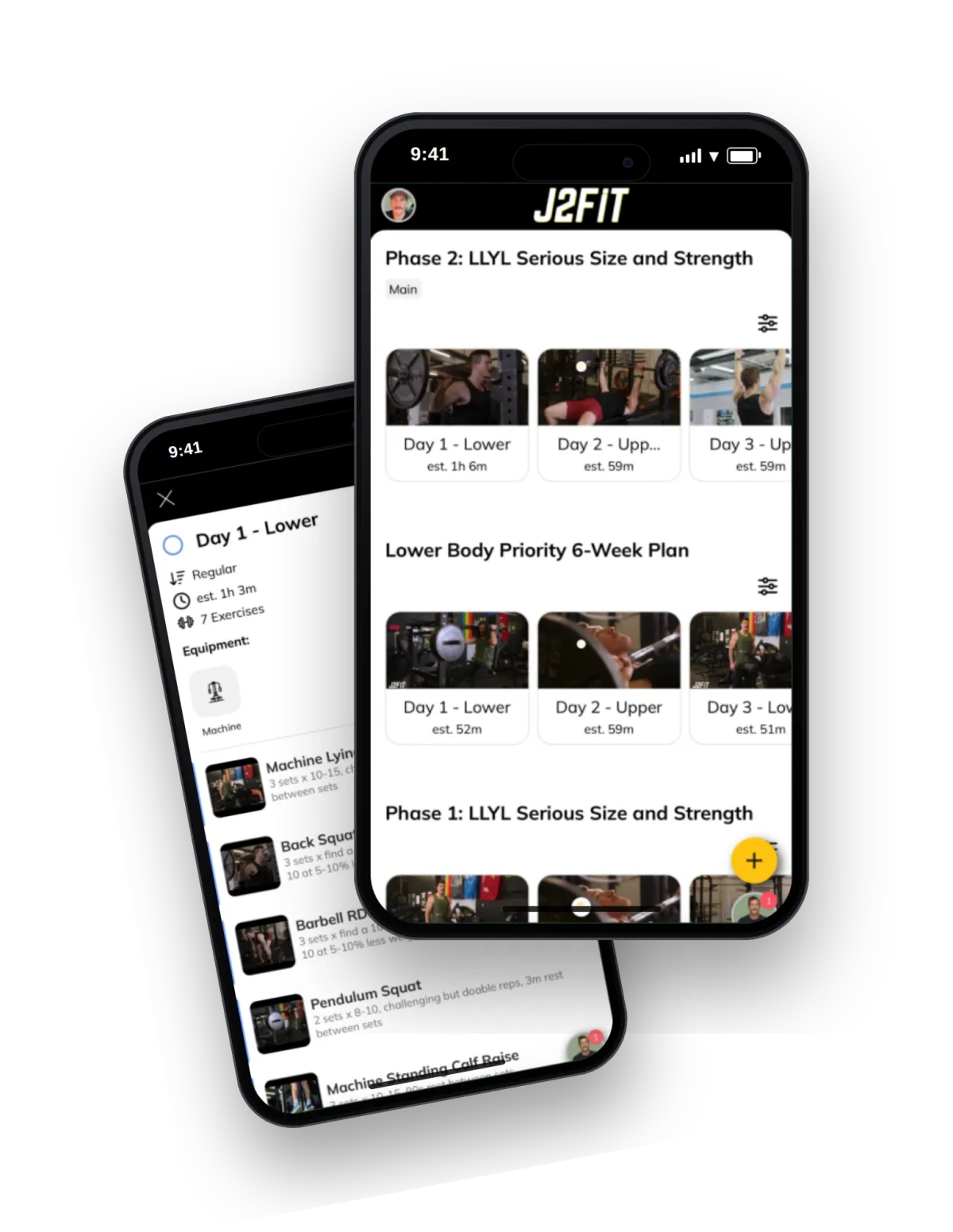
If you're gearing up for your own first meet, you don't have to build your warm-up and attempt strategy from scratch. Check out the Look Like You Lift Weightlifting Competition Series for meet-day preparation built exactly like the walkthrough above, explore Olympic lifting programming in the J2FIT workout app, or reach out about coaching if you want someone in your corner calling your jumps on meet day.
Train It With Structure.
Not Guesswork.
Olympic lifting programming in the app, or a coach building it around you.
— Mike