Aggression Comes From Confidence: Lessons on Competing as a Masters Weightlifter
As the second born son, I have always found myself in situations in which I either had to level up, or miss out. This isn’t something I feel is a bad thing, as wanting to keep up with my older brother and his friends throughout childhood made me into the person I am today.
Playing Up
Growing up I wanted to be and do everything with my older brother. He was cool, strong, fast, and athletic. He was and is a great brother. Being 2-3 years older than me, the age gap wasn’t very significant, but it was just enough. I remember playing rundown in the front yard with all his friends, who were in junior high when I was in grade school. They threw harder, ran faster, and were just more developed. I remember playing tag, I remember playing football. A few years makes a big difference, but as a youngster there was no time for waiting to develop, because I either played with them, or I didn’t.
Those early years led to me being a pretty athletic kid in my teens, and often meant I did well in sports. I found myself playing up a level and yet again playing with peers who were slightly better than me.
Through all that, I developed a deep love for competition, love of the grind, and a deep understanding and appreciation for the pursuit of getting better every day.
Fast forward nearly 30 years, and as I approach 40 my athletic days are over. I am no longer playing middle linebacker in high school or baseball. I am no longer running the 200m, hitting the back straightaway and leaving it all on the track. I am however lacing up the weightlifting shoes, pulling the belt tight, and attempting to move personal records above my head in the sport of Masters weightlifting.
How Can I Be MORE Aggressive in Competition?
Which brings me to today’s real discussion, which was a question from an athlete of mine who was new to competition…
“How can I be more aggressive without losing focus in competition?”
When she asked me this I was truly dumbfounded, because never before did I think about this. You see, this exact “issue” was something that was so innate to me that I never had to give it deep thought.
As a coach, I realize that my background and upbringing made me a certain type of athlete, but as a coach I need to understand that many of my lifters do not come from the same past.
So, I sat and pondered, and this is what I came up with…
Confident Aggression is Built Through Preparation
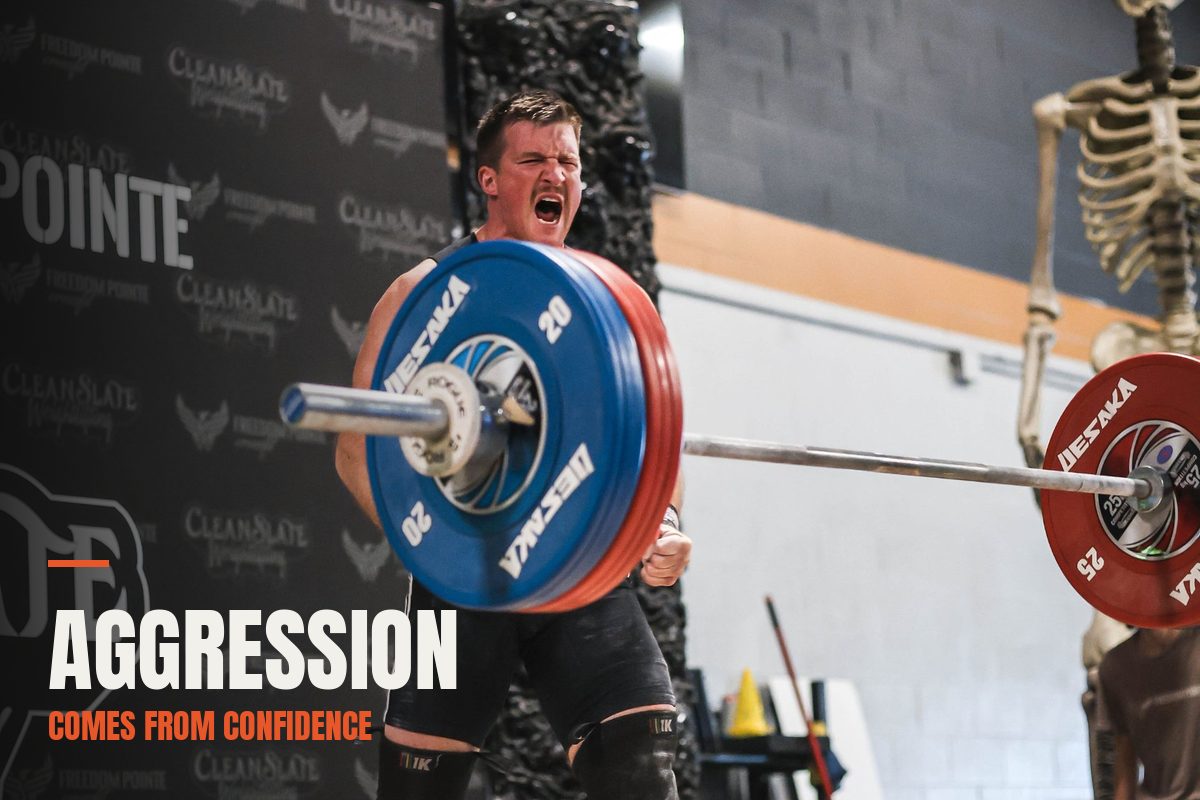
Aggression comes from confidence, and confidence comes from preparation.
It all starts with proper preparation. My best performances have come after a period of preparation where I had a great plan that was built for the goal, and I executed on said plan. The plan was not easy, nor impossible, but rather it was developed to push my abilities just enough.
My goal as a coach is to create a training plan and environment that challenges a lifter’s abilities both mentally and physically. They will get frustrated, they will fail in training, and they will question their own abilities.
It is a fine line.
I do not believe in making a program full of things my lifters will excel at. I am there to make them better, and often that is through failing just enough to adapt, but not enough to defeat.
I tell most of them that my programming is PASS/FAIL. You either do the loads, reps, and movements at the quality and number prescribed, or you don’t (for most of my masters lifters I will program ranges, rather than absolute numbers to hit, to better account for autoregulation).
If you can do the plan and complete the movements to the standard of quality that I have set for you, you are set. It’s that straightforward.
As a lifter, I also do these programs and understand the mental struggles and ups and downs, but there is a confidence and trust I have developed in the plan. I draw confidence from knowing that if I can get through training, I can compete with full confidence.
And when I am confident, I am aggressive.
When you are confident you are not worrying about the little things. You are locked in. When you are locked in, you can summon all the aggression you need, knowing you are ready for the moment that is in front of you.
Is Your Body Physiologically Prepared to Be More Aggressive?
You need to be confident in your body’s ability to handle the stress you are about to go through.
As I have gotten older, father time talks to me more, almost every day. When it’s time to compete, I need to feel confident that I will not break under the stress and strain I am about to put my body through.
That starts with a sound training program, one that pushes me but doesn’t break me. This is often like hitting a moving target, and this is often where many lifters (including myself at times) struggle. As a masters lifter, recovery and connective tissue issues become something you need to keep tabs on, otherwise you will never fully trust your abilities when it matters most.
In competitions, I find confidence in:
Being prepared physically
Following a program that didn’t break me before my meet
Choosing loads that are within my abilities at that time, or slightly above if I had a good lead up and was tracking for a bigger number (based on the data from the prior 4-6 weeks of training)
To Be the Fire, You Need to Spend Time IN the Fire
You need to spend more time in the exact situations that challenge your confidence, which means more time competing.
The initial question was asked by a lifter who had no competitive weightlifting experience. The layup answer here was that she needed to compete more to get more confident in that environment.
If you have never competed before, or if you have and are not a seasoned vet, you know how chaotic meet day can be. Weigh-ins, selecting openers, warming up, waiting for your attempts, watching lifters move up and down the board, seeing coaches go back and forth from platform to tables.
It’s controlled chaos.
This particular athlete got sucked into that vortex despite me telling her she needed to only lock eyes with me during all this.
I told her she would hear her name, she would see other lifters going, she would be jostled back and forth. And that’s all normal. The board is a living creature, and any experienced coach and lifter knows what I am talking about.
As a competitor, you need to gain experience competing, which includes not only what is done on the platform but also in the back rooms and waiting area. More importantly you need to practice putting your blinders on and focusing on only what you as the athlete can control, which is how you lift and how you put blind trust in your “handler” (the person running your warm ups and cards, often your coach or someone who is more experienced than you in this, or at the very least someone you have BLIND trust in).
As a coach, I also realize that this is something they can only start to develop by (1) doing meets, and (2) having me there helping them, so we as a coach/athlete team can develop communication and trust between one another.
Proper Planning Equates to Channeled, Confident Aggression
You need to follow a program that will challenge your abilities and limitations relentlessly, which you can then draw strength from, knowing you have done what is needed in training to compete well.
My job as a coach is to make you better, and if you are a competitive weightlifter it is to make you better on the platform. This means I need to isolate your technical breakdowns and strength limitations, and attack them through training.
I also need to create a plan that meets you where you are at, and to build and progress you towards being stage ready.
I also need to account for the unique differences lifters may have, such as what injuries they come in with, what defaults they revert back to under heavy loads and fatigue, and what lifestyle stressors and restraints I need to be aware of when programming.
If you are not following a plan that can account for these and accommodate your needs, while also not being an echo chamber filled with only the things you are good at or enjoy, then you most certainly will not be the most optimally prepared for meet day. Even if you feel ready, there is a strong chance you may go into the competition beat up, or maybe not ready to be beat up in a meet (from heavy PR load attempts), or just not confident because you KNOW you aren’t prepared.
Blind Trust Allows You to Put Your Blinders On and COMPETE
You need to find someone or some group that has seen you in your training and prior situations that you can lean on to draw confidence from, even if you don’t have it yourself.
As a coach, it’s hard to find a place where people see me as an athlete. When I train in the facility, most of my peers are the same athletes that look to me for the answers and the push. As an advanced lifter, what I find I need the most is other advanced lifters who have the same experience and understand the struggles I go through in competition.
For me, aggression isn’t the hard part, and neither is finding the perfect meet day mindset. For me it’s finalizing a plan of attempts, choosing attempts based on the board and the competition, and when necessary making unorthodox jumps to new loads that maybe I haven’t touched in training. This definitely can induce some panic for me, like anyone would have when staring down the barrel of fighting something that doesn’t want to be moved.
But confidence comes from having others in your corner who UNDERSTAND that, and know you as the athlete you are. They know your limits and your capacity, the same way I know my athletes.
So if you are a competing athlete, at any level, surround yourself with other lifters who are both at your level and above you if you can. Share with them your goals, be a part of the community. Let them see you, on both good and bad days. Have a presence on the training platforms, and be a good teammate. When it is time, they will reciprocate and often see more in you than you may see in yourself.
That’s a big part of why I’m building a team of masters lifters who train and compete together.
So, What's Next?
Back to the original question. “How can I be more aggressive without losing focus in competition?”
Aggression isn’t something you just turn on when you walk out onto the platform. It is the result of everything that came before it. The plan you followed, how your body is holding up, how many times you have been in that chaos before, and who is standing behind you at the table.
So I want you to be honest with yourself for a minute. If you are a competitive lifter, ask yourself:
Is your program actually built for you, your age, your injuries, your schedule, and your weaknesses? Or is it a template written for a 24 year old with nothing else going on?
Are you being challenged in training, or are you mostly doing the stuff you are already good at because it feels good?
Do you go into meets beat up, or ready to lay it all out on the platform?
When you are in the back room and the board starts moving, who are you locking eyes with?
If you hesitated on any of those, that’s not a knock on you. It just means there is more left on the table. I am almost 40, I still compete, and I still learn something about myself every training cycle. Getting older doesn’t mean your best lifts are behind you. It just means you can’t afford to waste time on a plan that wasn’t built for you.
That’s what I do. I write programming for masters weightlifters who want to walk onto the platform knowing they are ready, not hoping they are.
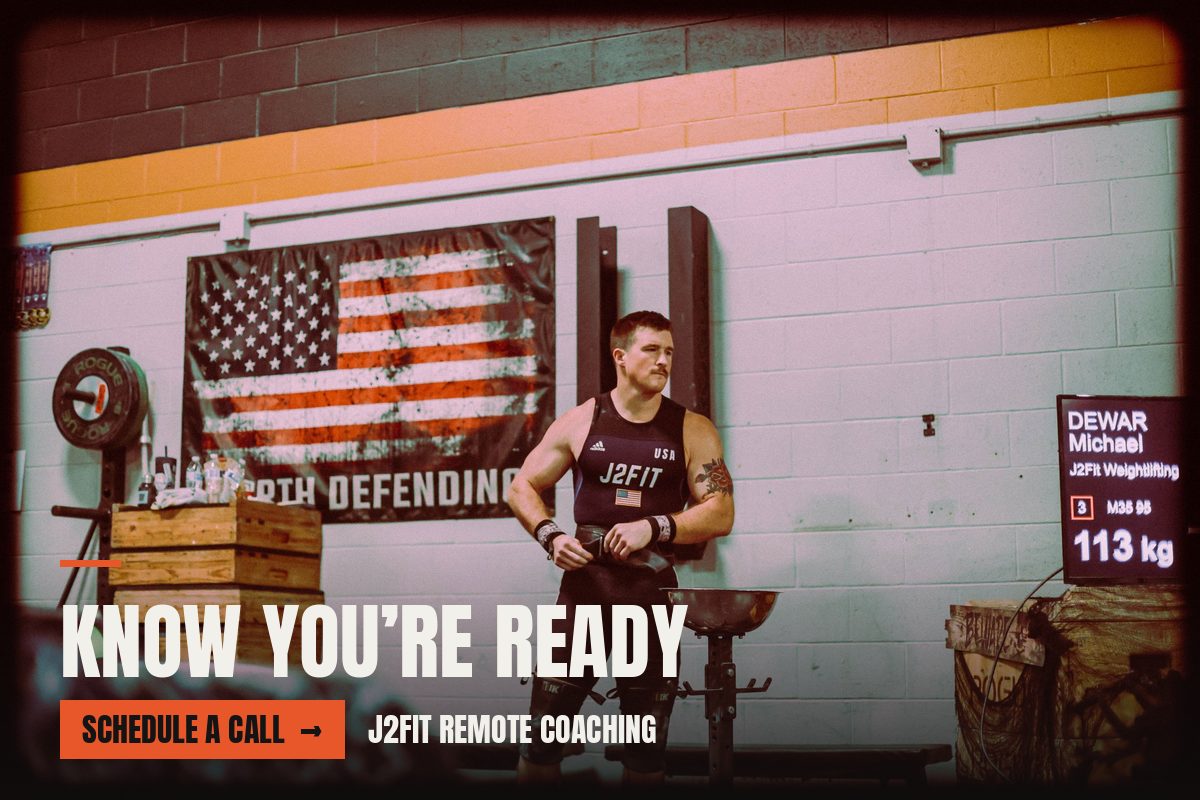
If you want a coach in your corner who builds your plan around your lifts, your body, your recovery, and your meet schedule, schedule a call with me. We’ll talk about where you are at, where you want to go, and how we get you there.
The next time your name gets called, I want you to know you’ve done the work. Then go be aggressive.
— Mike
Stop Guessing.
Train With a Coach.
Individualized weightlifting programming for masters and competitive lifters who want to show up ready on meet day.